I'm Working Full-Time Just to Stay Broke.
Inside DoorDash's 94% Acceptance Rate Trap: The Math They Don't Want You to See

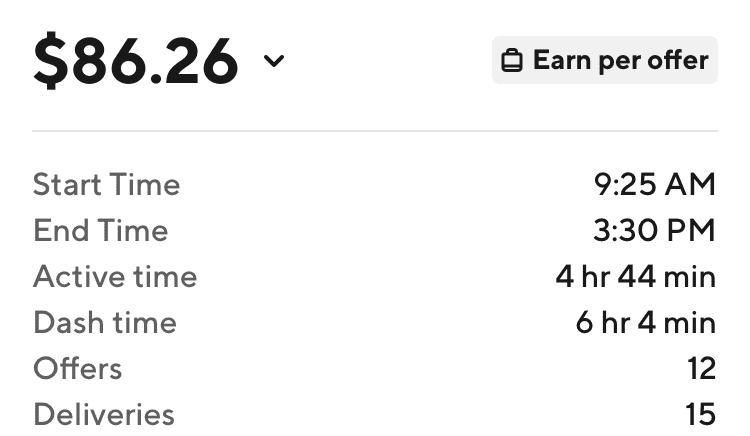
I’m sitting in my car looking at my DoorDash earnings. Last shift I worked 6 hours and 4 minutes. Made $86.26. Fifteen deliveries.
My rent is $1,900. Due in three weeks.
Here’s the math they don’t want you to see.
The Numbers
I work 10-hour mixed shifts across morning, noon, and evening. That gets me around $800 per week if I maintain my metrics.
Monthly gross: $3,200
But I’m self-employed. That means:
Self-employment tax (15.3%): $489.60
Federal income tax (~5% after deductions): $160
Taxes total: ~$650/month
Monthly expenses after taxes:
Rent: $1,900
Gas ($20/day, 25 days): $500
Car insurance & maintenance reserve: $493
Electricity, water, basics: $150
Food (minimum): $400
Phone (required for app): $50
Total: $4,143
Monthly deficit: -$943
My car has 75,000 miles. I just paid $1,200 for four new tires. Next month I need rear brakes. That’s another $400-600.
I am working full-time to go deeper into debt.
The Trap
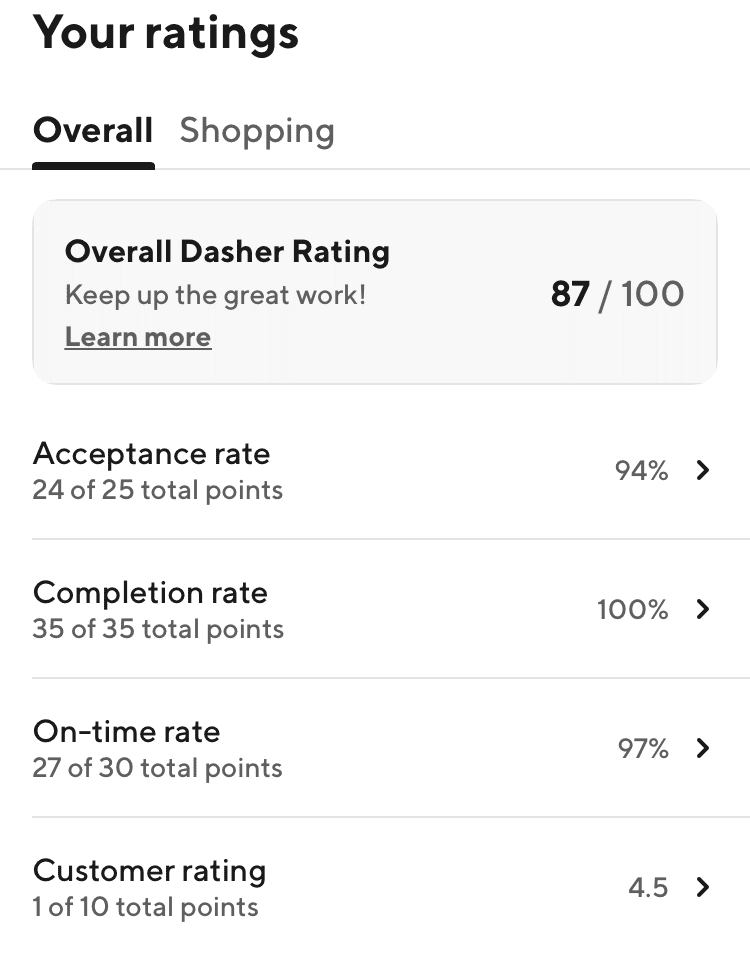
Look at my DoorDash “Ratings and Rewards” screen. See that number?
Acceptance rate: 94%
That’s 24 out of 25 offers accepted.
Here’s what DoorDash doesn’t tell you in their marketing: Drop below certain thresholds and you lose “priority access” to higher-paying orders, according to DoorDash’s own Dasher Rewards Program documentation. The app will show you $2.50 orders for 9 miles. You’ll watch better orders go to other drivers.
DoorDash has engineered a system where declining unprofitable work is punished more severely than accepting it. That is not independence, that is coercion.
So when DoorDash sends me an order that loses money after gas, I have three choices:
Accept it and lose money
Decline it and risk my acceptance rate
Decline it and definitely lose priority access
I accept it. Every time.
The app also tracks:
Completion rate: 100% (35 of 35 deliveries)
On-time rate: 97% (27 of 30)
Customer rating: 4.5
One recent notification: “Missing drop-off photos: 30%+ of your leave-at-door deliveries lacked drop-off photos.”
Another: “Confirm delivery just after drop-off: Recently, you spent 10+ minutes near a drop-off before completing delivery in the app.”
They are measuring everything. Any metric drops, you get flagged. Get flagged enough, you get deactivated.
The Legal Fiction
Under U.S. labor law, the definition of an employee is a worker who is economically dependent on the employer and subject to their control. DoorDash controls price, assignment, work intensity, location, scheduling, performance metrics, and disciplinary consequences. The worker controls only the car they are slowly destroying. That meets every standard legal test for employee classification, economic dependence, behavioral control, and integration into business operations.
DoorDash calls me an “independent contractor.”
But I cannot:
Set my own prices
Refuse unprofitable work without punishment
Negotiate terms
Take breaks without algorithmic consequences
Decline more than 3 orders per hour without losing priority access
What I must do:
Maintain high acceptance rates to get decent orders
Respond within seconds
Follow exact delivery protocols
Provide my own vehicle, insurance, gas, maintenance
Pay my own taxes
Accept all liability
I can see every order before I accept it:
The destination
The miles I’ll drive
The exact pay
I can see when an order loses money. Fourteen miles for $9. After gas, that’s maybe $3-4 for 30-40 minutes of work.
I accept it anyway.
Because declining multiple orders per hour triggers “platform deprioritization” according to widespread driver experience and DoorDash’s tiered rewards structure. My acceptance rate drops. I lose access to better orders. Eventually, I lose the ability to schedule shifts entirely.
This isn’t about hidden information. It’s about algorithmic coercion.
The platform shows me it’s a bad deal. I take it anyway. Because the punishment for rational economic decisions is starvation.
According to DoorDash’s legal structure, I am running my own business.
According to the actual system, I am paying DoorDash for the right to work.
The Endgame
My car: 2018 sedan, 75,000 miles, needs brakes next month.
When something major breaks - transmission, engine, suspension - I have three options:
Fix it (no money)
Finance it (already in debt)
Stop working (can’t pay rent)
There is no unemployment insurance for contractors. No workers’ comp. No sick days. No health insurance.
One breakdown and I’m done.
But here’s what makes this different from previous forms of labor exploitation: The algorithm makes it invisible.
There’s no boss to confront. No workplace to organize. No clear point where the company “made a decision” to pay me below minimum wage.
It’s just the app. The metrics. The acceptance rate.
When I can’t pay rent, DoorDash will say: “He could have declined unprofitable orders. He chose to accept them.”
When my car fails, they’ll say: “Vehicle maintenance is the contractor’s responsibility.”
When I point out that declining orders triggers deactivation, they’ll say: “Our system optimizes for marketplace efficiency.”
The system is designed so that every failure is mine. Every success is theirs.
The Math They Hope You Won’t Do
Let me show you one shift in detail.
October shift: 6 hours 4 minutes total time. 15 deliveries. $86.26 earned.
After expenses:
Gas (~$7 for approximately 45 miles)
Vehicle wear using IRS mileage rate ($31.50 at $0.70/mile)
Self-employment tax ($13.20)
Real earnings: $34.56
Actual hourly rate: $5.70/hour
This is below minimum wage in every U.S. state.
Before vehicle depreciation. Before maintenance reserves. Before federal income tax. Before insurance costs.
You did everything right, and the system still paid you like a child in a factory in 1890.
But because I’m a “contractor,” minimum wage doesn’t apply.
The Question
DoorDash, Uber, Instacart, and every gig platform operate on this model:
Transfer all costs and risks to the worker. Retain all control and profit.
They will say I’m free to stop anytime.
They’re right.
I’m also free to starve.
So here’s my question to DoorDash, and to everyone reading this:
At what acceptance rate does an “independent contractor” become an employee who can’t say no?
At what point does “algorithmic optimization” become wage theft?
And when my car breaks down next month and I can’t pay rent, which emergency room do I go to, because I have no health insurance, and who pays that bill?
The app will just send my next order to another driver.
The Replacement System
You’ve seen the ads. Beautiful women in clean cars, smiling. “Make extra money on your schedule.” “Be your own boss.” The TikTok videos. The Instagram posts. The promise of freedom.
They don’t show you this article. They don’t show you the math. They don’t show you that working full-time puts you $943 deeper in debt every month. They don’t show you the 94% acceptance rate trap.
They show you the beginning. Never the end.
And when I break, when my car dies, when I can’t make rent, when the debt becomes unsurvivable, there’s already someone else downloading the app. Someone who hasn’t done the math yet. Someone who still believes the marketing.
There are always more of us.
The app only works as long as the next person doesn’t know.
So here is the real power: Tell them before they start.
The collapse doesn’t begin with lawsuits. It doesn’t begin with strikes. It begins when the new driver doesn’t download the app.
This is why organizing is impossible. By the time you understand the trap, you’re too exhausted and too broke to fight. And the driver who replaces you? They’re starting from zero. No collective memory. No union. No warning from the previous generation of workers.
Each broken driver teaches nothing to the next one.
This isn’t a bug in the system. This is the system.
What They’re Really Building
You think this is about food delivery? It’s not.
This is the pilot program for dismantling every labor protection won over the last 150 years. The 40-hour workweek. Minimum wage. Workplace safety standards. The right to organize. Unemployment insurance. Workers’ compensation. Health benefits.
All of it, gone.
Not through legislation. Not through public debate. Through a phone app and a legal term: “independent contractor.”
Platform-based gig work (Uber, DoorDash, Instacart) generated approximately $450-550 billion globally in 2024 according to industry analysts. But that’s not the endgame. That’s just proof of concept.
Once this model proves it can:
Extract labor below minimum wage
Eliminate all worker protections
Prevent organizing through algorithmic isolation
Avoid all legal liability through forced arbitration
...then it scales to every sector. Not just delivery drivers. Everyone.
Your Uber driver today. Your healthcare worker tomorrow. Your child’s teacher next year. Every job that can be “optimized” through an algorithm will be.
And the beautiful part, for them, is that it feels like progress. It feels like innovation. It feels like the future.
AI isn’t breaking the system. AI is completing it.
The endgame isn’t chaos. The endgame is order. A perfect, smooth, quiet order where:
Suffering is individual
Causes are invisible
Resistance feels futile
Every failure is your own fault
And history stops moving forward
A soft prison shaped like convenience.
The Joke They Don’t Want You to Laugh At
Do you remember what made the Catholic Church attack Monty Python’s Life of Brian?
Not blasphemy against God. Mockery of the priests.
The film made it acceptable to laugh at the intermediaries, the ones who claimed to speak for the divine, who demanded obedience, who collected tithes and promised salvation.
Once people started laughing, the spell broke.
So here’s what I want you to do with this article:
Laugh at them.
Laugh at the TikTok ads showing beautiful people earning “extra money.”
Laugh at the phrase “be your own boss” when you can’t decline 3 orders per hour.
Laugh at “flexible schedule” when the algorithm punishes you for logging off.
Laugh at “opportunity” that traps you in $943 monthly debt.
Laugh at the priests of platform capitalism promising freedom while building digital feudalism.
Make the joke spread faster than the marketing.
Because once enough people are laughing, once enough people see the math, understand the trap, and recognize the con, the new workers stop downloading the app.
And without a steady supply of workers who haven’t figured it out yet, the whole system collapses.
My Question Still Stands
DoorDash: At what acceptance rate does an independent contractor become an employee who can’t say no?
I’ll wait for your answer.
But I won’t wait hungry. I won’t wait homeless. I won’t wait quietly.
This article is permanent. The math is checkable. The screenshots are real. And every driver reading this knows I’m telling the truth.
Your move.
This article is based on verified DoorDash driver data from October-November 2025, including app screenshots, earnings statements, and IRS self-employment tax obligations.
If you’re already driving, I’m not telling you to quit tomorrow. I know you can’t. I’m still driving too. But document everything. Talk to other drivers. Share this math. Because the only way out is through, and the only way through is together.
If you are a gig worker on any platform experiencing similar conditions: you are not alone. Share your story. The only way this system changes is when enough people stop accepting the lie.
Standard Reference Note
This concept is developed from the philosophical tradition that understands dignity as intrinsic value: value independent of function or productivity. For background, see: Stanford Encyclopedia of Philosophy, “Dignity”
Licensing and Use
Open-Source Philosophy: All original conceptual frameworks, definitions (e.g., Blind Architectures, Rationalist Heresy, Vassal Order), and historical syntheses within Unspun Thread are released under a liberal, non-commercial open-source license.
Attribution Required: We encourage, and insist upon, the free use of our ideas, frameworks, and insights by thinkers, students, journalists, and legal professionals worldwide. Attribution is the only cost of use.
Standard Citation: When referencing or utilizing the core theses of this work, simply citing Unspun Thread and the title of the specific article (e.g., The Blind Architectures: Tracing the Historical, Legal, and Sociological Bias Embedded in AI Code) will suffice.
The ideas generated here are for the defense of the The Sacred Useless: Dignity and the Right Not to Serve and the sovereignty of the human mind.
The Continuum Forge – Unspun Thread